
We are currently packing the first public version of Until the Bells Stop. Not the Steam demo. Not a miniature version of everything we eventually want the game to contain. A focused four-Bell itch.io demo.
That distinction matters because roguelites are unusually good at making a developer believe that one more upgrade, three more relics and seven more enemies are absolutely essential before another human being is allowed to touch the game.
They usually are not.
Can four Bells produce enough of the real game that somebody finishes a run and wants to start another one?
Three ways to bury somebody
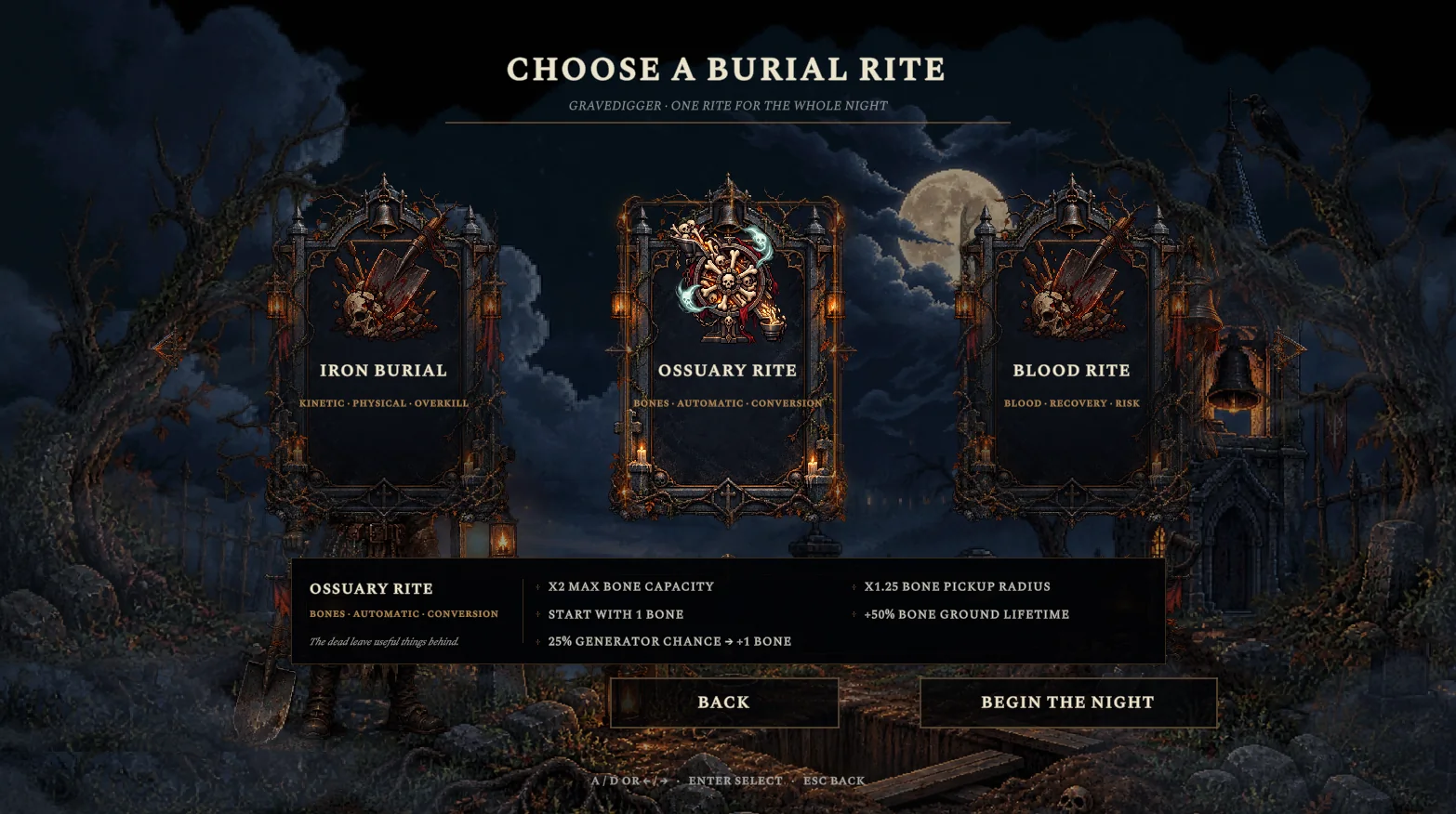
Before entering the run, the Gravedigger chooses one of three Burial Rites. They are not rigid classes. They bias the direction of the run while leaving shared upgrades available, because discovering hybrids is part of the point.
IRON BURIAL
More force, more corpse launch, stronger stagger and more value from putting enemies into things that were not designed to receive enemies at speed.
OSSUARY RITE
Bones become infrastructure: more capacity, more collection reach, longer-lived drops and better access to Bone-driven converters and payoffs.
BLOOD RITE
Combat-earned recovery becomes stronger, low health becomes dangerous in a useful way, and once per run Death's Door can refuse a lethal hit.
There is no Blood meter. Being nearly dead is sufficient administration.
Then we need enough upgrades to actually build something
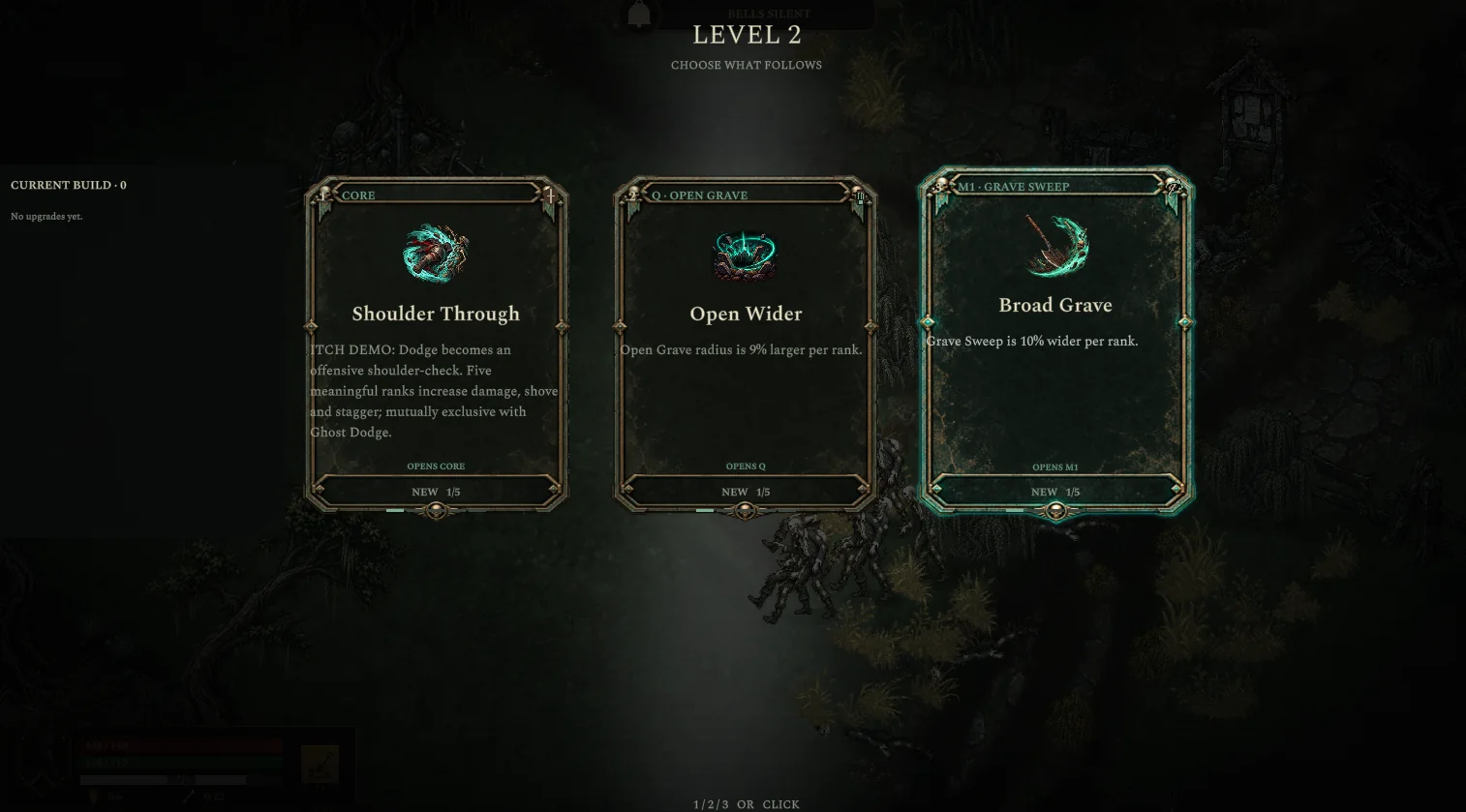
A successful demo run is currently intended to give roughly eight to twelve normal level-up choices. The available demo pool will be larger — around fifteen to twenty shared upgrades at once — so two runs do not simply reproduce the same build.
The wider Gravedigger catalogue is already much larger. The first demo is a curated slice. Representative cards include Broad Grave, Broken Wrist, Pallbearer's Reach, Deep Impact, Aftershock, Open Wider, Six Feet Under, Bone Splinter, Grave Nail, Fresh Soil, Blood Harvest, Long Step, Ghost Dodge, Shoulder Through and Second Wind.
We would rather have eighteen cards whose interactions we understand than fifty cards whose primary interaction is making the balance spreadsheet frightening.
Five relics, because relics should actually matter
Normal upgrades construct the build. Relics are supposed to bend it.
For the first demo we have reduced the Gravedigger relic pool to exactly five:
- Pallbearer's Grip — launch one enemy into another and the collision itself becomes damaging.
- Undertaker's Coat — throw an enemy or corpse into graves, tombstones or scenery and the impact creates a burial explosion.
- Bone Rosary — collected Bones orbit the Gravedigger and can be consumed when enemies make contact.
- Ossuary Key — carry enough Bones into Burial Slam and the Slam can spend them on a radial burst of Bone shards.
- Mass Grave Seal — enemies controlled by Open Grave can become Gravebound, allowing Burial Slam to cash out the group with an additional shockwave.
The normal target is around two relics during a run, with a third possible if the player explores well. Five sounds small. That is precisely why it is useful. If we are testing whether relics genuinely change builds, we want players to encounter combinations often enough that we can actually learn something from them.
Then the Bell interferes
The Bells are not supposed to hand out another ordinary level-up. They transform what the player has already been doing.
- The Shovel Is a Bell — repeated Grave Sweep hits eventually emit a resonance shockwave.
- Open Them All — Open Grave creates two smaller satellite graves around the main one.
- Bone Storm — a deliberate Bone cash-out produces a temporary radial Bone Storm.
- No Half Measures — Iron Burial can turn sufficiently violent knockback into even more absurd launch and collision consequences.
- Ossuary Opens — excess Bone capacity becomes an orbiting reserve that eventually discharges.
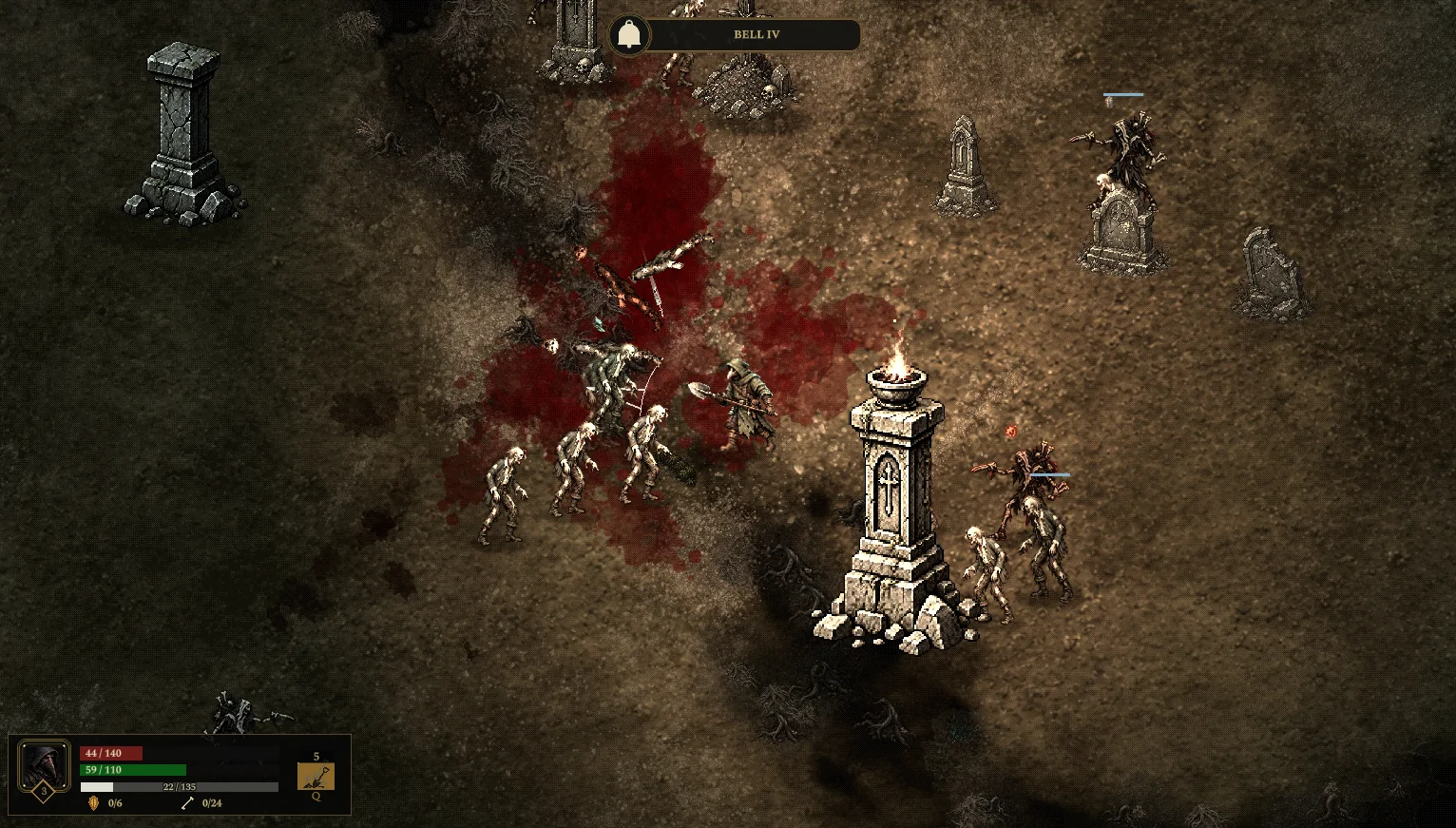
The first three Bells can offer these transformation choices. Bell IV is allowed to concentrate on making the situation worse instead of interrupting the run with another menu.
The demo also needs somewhere to go
Combat alone would give us an arena. We want Blackwood Parish to feel like a place.
The current minimum exploration package for a run includes two Healing Sanctuaries, a Crooked Shrine, a Sealed Crypt, a Guarded Incident, a Bell Fragment Incident and a Merchant. The Sealed Crypt is fixed and learnable. The other opportunities are selected from authored locations using a reproducible run seed.
We do not want landmarks sprinkled onto arbitrary coordinates. Blackwood should remain learnable while individual runs change where temptation appears.
And importantly, the player is not expected to visit everything. A normal run should expose only some of the available opportunities. The rest become reasons to wonder what was behind the road you decided not to take.
What we deliberately left out
This part has probably taken more discipline than adding things.
The first demo does not need the entire future Gravedigger upgrade catalogue. It does not need every relic. It does not need all nine Bells. It does not need five playable characters. It does not need a huge permanent-progression system. It does not need to demonstrate every idea we have written down.
It needs the Gravedigger. A shovel. Three Rites. Enough upgrades to build something strange. Enough relics to change direction. Enough of Blackwood to create greed. And four Bells that make the player understand why there are another five waiting later.
The demo succeeds when somebody finishes a run, understands what they built, and immediately has an idea for what they would do differently next time.
That is the package we are assembling now. Small enough to finish. Large enough to go wrong in several interesting ways.
Which, according to Bureau records, is usually where the useful incidents begin.