
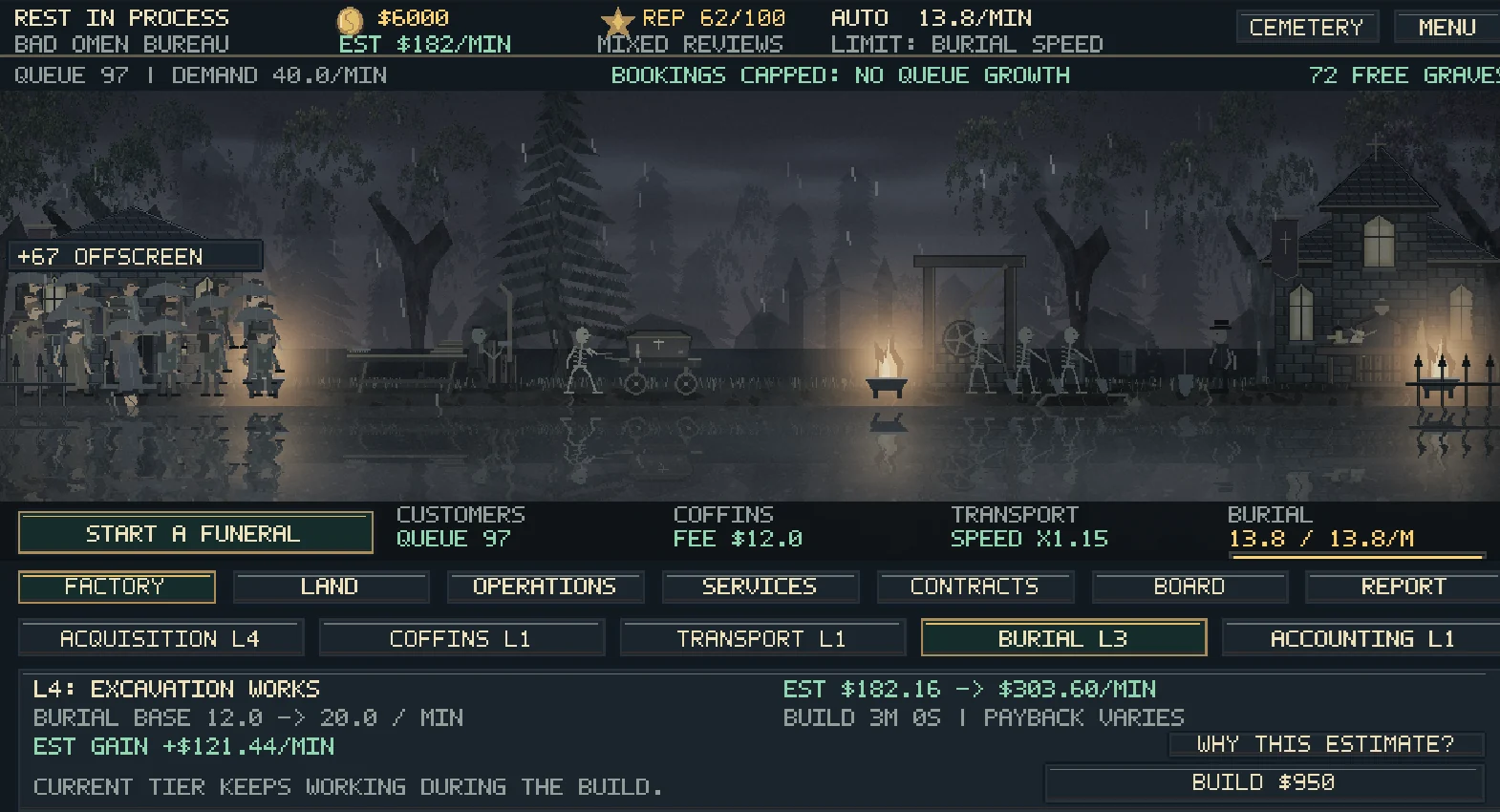
One of the first things you do in Rest in Process is make a coffin by clicking on a workbench. Several times. Then you carry it, dig a grave and finish the funeral. It would be much more efficient to have someone else do all of that. Which is precisely the point.
I keep returning to the same question when designing the game: how can an upgrade feel good if you never understood the problem it solved?
Idle games have a wonderful habit of turning dull work into a pleasant ritual. The actions themselves are usually not thrilling. You click. A number goes up. You click again. But then the game lets you replace those clicks with a worker, a machine or a better process, and suddenly all the time you spent doing the boring thing has a purpose. You can feel the time you have bought back.
First, understand the assembly line
Our funeral process has five stages: accept the customer, build the coffin, transport it, bury the body, complete the service. Early on, you participate directly. You see how long each stage takes and where the entire operation gets stuck. It is not elegant, but you know exactly what is happening.
When the first skeleton joins the staff, that little change has meaning. You remember doing the work yourself. When transport is upgraded, you can watch the cart move faster. When burial slows the operation down, you can see the queue building behind it. That is a much better kind of progress than a mysterious multiplier tucked away in a menu.
This is also why I like having the whole business visible on the screen. We could represent every department with a bar, and a bar is useful, but the game becomes more interesting when the world helps explain the numbers. Customers arrive on the left. The procession moves through the cemetery. The undead get on with their jobs. In the background the weather changes, and nobody gets a day off.
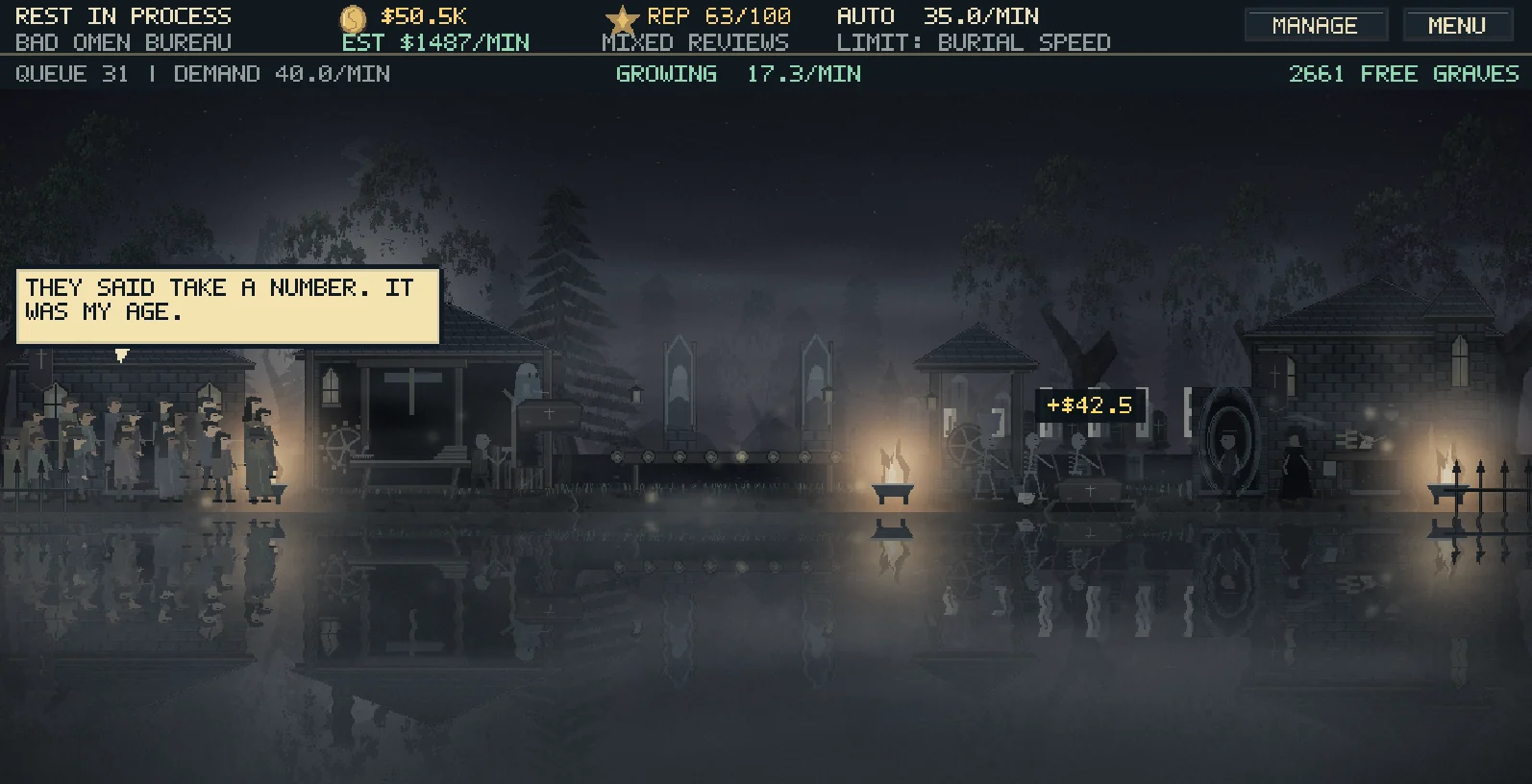
Then we take away the clicking
A strange thing happens when an idle game starts to work. The player has spent time trying to make everything faster; then, when the system finally runs, there is less for the player to do. That sounds like a design problem. I think it is actually a chance to change the kind of decision you make.
At the beginning you are an employee. After a while you are the manager. You stop thinking about one coffin and start thinking about how many funerals the whole business can handle, whether the cemetery has room, whether an upgrade pays for itself and how demand compares with burial speed.
Of course, the balance is delicate. Too much manual work and the first few minutes are a chore. Too much automation too early and the staff feel like decorations. Too little to decide after the operation becomes efficient and the whole game turns into watching a screen that does not need you. We are still tuning that transition.
We want a satisfying machine, not just bigger numbers
The alpha already has operations, upgrades, land, services and contracts. The question is whether those pieces produce interesting choices in practice. A queue of 90 customers looks dramatic, but if the obvious answer is always to buy the next burial upgrade, that is not a deep management system. It is a shopping list.
I want moments where you notice that you have been solving the wrong problem. Where your business earns more money but the bottleneck moves somewhere else. Where buying more land helps for a while but does not solve the underlying issue. Where a contract is tempting but makes you wonder whether the existing operation can cope.
We have to earn those moments through good numbers, useful feedback and clear explanations. A small alpha is a very good place to discover where we have not done that yet.
Tell us where the work stops being fun
If you play Rest in Process, I would particularly like to know when you stopped clicking and started managing. Was that transition satisfying? Did you wish it happened sooner? Did you understand what to improve next? Were you happy to watch the cemetery for a while, or did you run out of reasons to care?
There is a free browser alpha on itch.io. It is rough in places, and browser saving is still experimental, but the central idea is already there: do the work, build the machine, then find out whether you have actually made a good business.
And yes, everybody on the payroll is dead. We considered other staffing models. None seemed quite as cost-effective.