
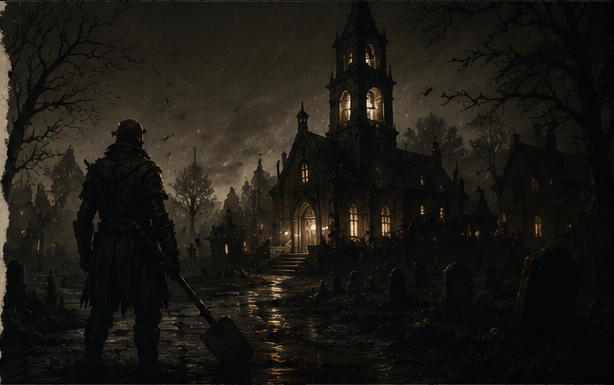
A shovel is a useful weapon for a game designer because nobody needs a paragraph explaining what it should feel like. It is heavy, it has reach and it moves dirt. If somebody swings one at you, the correct response is not to inspect its elemental damage type.
That physical expectation is the foundation of the Gravedigger in Until the Bells Stop. He is our starting character: slower and tougher than a nimble ranged hero, built around knockback, graves, bones and heavy attacks. The shovel is not a novelty item attached to an otherwise generic moveset. It is supposed to determine how he solves problems.
Start with three deliberate actions
The core combat is intentionally manual. Grave Sweep on M1 is the fast, broad attack: a horizontal shovel swing with a forgiving arc and strong knockback. Burial Slam on M2 is the commitment: a slower overhead strike that costs stamina, hits hard and sends a shockwave through the ground. Open Grave on Q is the signature setup tool, erupting spectral hands from the earth to root and pull enemies into a position the Gravedigger can exploit.
Those three actions need to feel good before a single relic is involved. That means clear anticipation, contact and recovery; hit reactions; dirt and debris; weapon trails; short hit-stop where it earns its place; and enough knockback that the player can read the result of a swing immediately. We are deliberately not chasing huge frame counts. The richness has to come from layered response rather than pretending we have an animation budget we do not have.
The build is allowed to become absurd. The input that started it should remain understandable.
Knockback is not decoration
The most important design choice was treating knockback as a resource instead of a cosmetic reaction. If Grave Sweep moves an enemy, that movement can matter. A target can hit a grave, a prop, a hazard or another piece of battlefield logic. A heavy attack can turn positioning into damage. Later upgrades can make the environment part of the build rather than merely the place where the build happens.
That also changes how the player looks at a crowd. The question is not always which enemy has the least health. Sometimes it is which enemy can be moved into the worst possible place for everybody else. The Gravedigger should feel like somebody using mass, ground and corpses as materials.
From shovel to engine
Roguelite upgrades become interesting when they alter behaviour rather than quietly increasing a number. Our working model for Gravedigger builds is generator → converter → payoff. A manual action creates a useful state or material, another effect converts it into something more dangerous, and the player deliberately cashes it out.
One direction is environmental catastrophe: sweeps and heavy hits generate displacement, the environment converts that movement into secondary effects, and Burial Slam becomes a natural finisher. Another is the bone engine: kills and relic effects create physical bones, the player collects them as a real resource, and later effects can store, orbit, launch or consume them. A heavy build can focus on repeated shockwaves and armour breaking. Open Grave can become the control engine that gathers a pack so the next deliberate attack lands on exactly the wrong group of people.
We do not want those to become five rigid classes hidden inside one character. Hybrid builds are more interesting as long as the player can still explain why the screen just exploded.
The combo we were happy to see players find for themselves
One encouraging playtest moment came from a very simple interaction. Players discovered that Open Grave could gather and hold a pack, then Burial Slam could cash out that setup with a concentrated heavy hit. Nobody needed a tutorial saying Q then M2. The geometry of the abilities suggested it.
That is the sort of combination we want more of: actions that are individually obvious but become better when the player notices how they fit together. We are not building a fighting game command list. The complexity should emerge from situations and build choices, not from memorising an input sequence on a wiki.
Why M1 still matters at the end of the run
There is a trap in spectacle-heavy roguelites where the primary attack becomes ceremonial. The screen clears because the build is running itself and the player is mostly transporting it to the next group of enemies. We enjoy automatic secondary effects, but we do not want them to erase the Gravedigger.
Grave Sweep has no stamina cost by default for a reason. Even when resources are empty, the character can still act. Burial Slam is stronger but constrained by stamina. Open Grave creates a larger cooldown decision. Relics and upgrades can make each of those actions trigger enormous secondary consequences, but the player should still care where they are aiming and when they press the button.
That requirement gets harder late in a run. Bone shards, shockwaves, corpse interactions and grave effects can fill a screen quickly. The answer is not to make the build less exciting; it is to preserve visual hierarchy. The shovel arc, immediate combat action and lethal enemy telegraphs have to remain readable underneath the spectacle.
Armour should be a problem, not a second health bar
The same philosophy applies to defensive enemies. We recently introduced a shared Armour/Break layer because simply giving a target more hit points does not create a new decision. Grave Sweep can still chip armour, but Burial Slam and other heavy or terrain-based impacts are much stronger at breaking it. A break creates a short punish window, turning protection into something the player responds to rather than something they merely wait through.
Different build directions can eventually solve armour in different ways — bones, terrain, control, repeated sweeps — but the foundation is straightforward: the player should recognise the protected state, know that a heavier answer exists, and feel the moment the defence gives way.
The fantasy we are trying to protect
At the beginning of a run, the Gravedigger should read instantly: broad silhouette, large shovel, physical hits, dirt and weight. By the later bells, the same character can be standing in the middle of shockwaves, bones, spectral hands and chain reactions. That growth is the reward for understanding the systems and building something coherent.
The phrase we keep returning to is "I built a catastrophe." The important word is built. If the game simply hands you a catastrophe, there is no ownership. If the player can trace the disaster back to a sweep, a grave, a bone, a relic choice and a badly positioned enemy, then the spectacle tells the story of the run.
We are still tuning numbers, animation, final VFX and the exact breadth of the item pool. The design target is less negotiable: the shovel has to remain a shovel, even when it has become the first step in a chain of events that would concern a competent local authority.