
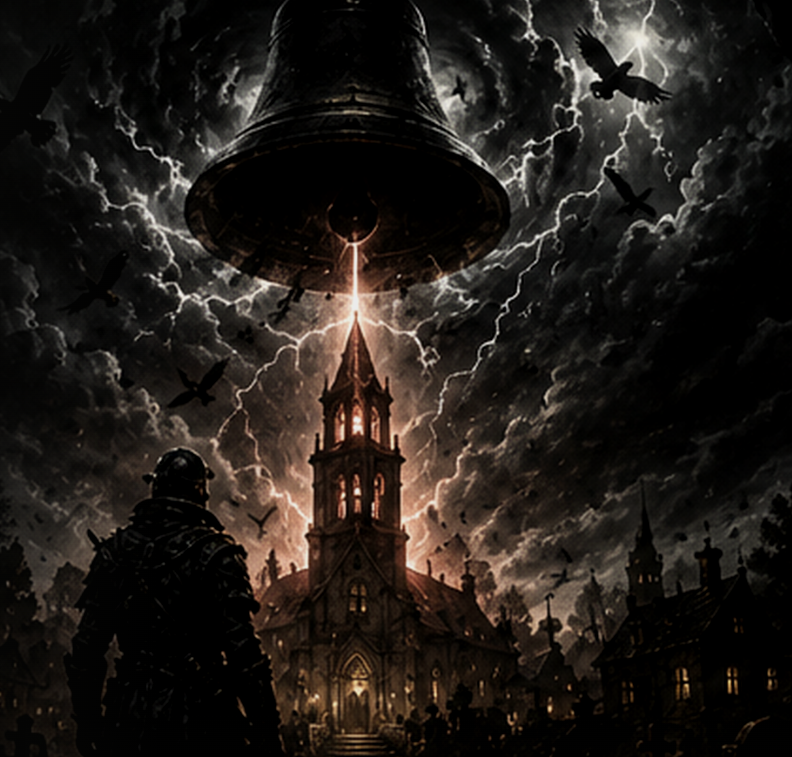
A survival roguelite needs pressure. Time passes, enemies get harder and the run moves toward something worse. The obvious solution is a clock and a difficulty curve. Both are useful, but neither is particularly memorable on its own. We wanted the passing of time in Until the Bells Stop to feel like an event the player could hear, see and eventually dread.
That is where the bells came from. There are nine of them in a run through Blackwood Parish, and our most important rule is that the bell is not just a timer. It is the game director, a world-state transition and a recurring piece of spectacle. When it rings, something must become different enough that the player can feel they have entered a new part of the night.
If the bell rings and the only result is enemies +15% health, we have not designed a bell. We have designed a spreadsheet with sound effects.
The same place, getting worse
Blackwood Parish is designed as one continuous world: forest, farm, ruined village, cemetery, church, crypt and the roads between them. We do not want to throw that geography away every few minutes. The interesting part is letting the player learn a place and then making that knowledge matter when the place changes.
A sealed crypt can be discovered early and remain useless until the Third Bell opens it. A route that felt safe can become compromised later. Corruption starts to appear. Environmental hazards begin attacking. The church route eventually opens as the night approaches catastrophe. By Bell IX, the player is still in Blackwood Parish, but the parish has accumulated enough consequences that the opening minutes should feel like a memory from another evening.
That continuity matters because transformation is only meaningful if you remember the before. A burning building is scenery if it was always burning. A familiar building becoming dangerous after you have passed it three times is a decision.
Nine bells, nine jobs
The bells do not all need to perform the same trick. In fact, they should not. Early bells teach the structure of the run and introduce new forms of pressure. The middle of the night begins changing the world more aggressively. Later bells combine threats the player already understands and then ask them to navigate those combinations while their own build is becoming increasingly unreasonable.
- Early bells can introduce new enemy roles, atmosphere changes and the first unmistakable escalation.
- Bell III is a natural point for the world to open: remembered sealed locations can become available and exploration decisions change.
- The middle bells can introduce visible corruption, elite pressure, the Mourning Giant and environmental hazards.
- Bells VII and VIII should make the parish feel unreliable: routes change, combined mutations become normal and the final church path opens.
- Bell IX is not a routine difficulty step. It is the catastrophic state and the doorway to the Final Incident.
The exact balance numbers will change as we test the full run. The qualitative job of each bell should not. Every bell needs at least one consequence that affects what the player can see, fight, explore or decide.
The bell should interrupt your plan
One of the reasons we like this structure is that it makes time part of exploration rather than merely a failure condition. A player might know the next bell is close and see something interesting just off the road: a shrine, a sealed place they have been waiting to revisit, a merchant, or a light where there should not be one. The question becomes whether the detour is worth the remaining time before the world changes again.
That creates a kind of greed we want to encourage. Staying near familiar enemies should remain viable; exploration cannot be mandatory homework. But leaving the safe route can offer relics, bargains, Bell Fragments, evidence, healing, shortcuts or dangerous optional encounters. The bell makes those choices urgent because the opportunity may become better, worse or simply different after it rings.
The ideal thought is not, "I have forty seconds left." It is, "The next bell is almost here, but that light is just over there."
Presentation matters because mechanics can be invisible
A world-state system can be technically sophisticated and still feel like nothing happened. That is why each transition needs presentation as well as logic: the bell sound, a brief ceremonial emphasis, changes in lighting or fog, environmental response, a title, and ideally a consequence somewhere in the world the player can understand.
We have already learned one useful lesson during development: simply making everything darker is not the same thing as making the night more threatening. If late bells become unreadable, we have damaged the combat and hidden our own work. Darkness needs to come from palette, atmosphere, silhouettes, local contrast and corruption as much as from turning down the lights.
That rule becomes more important as the player build grows. Late-run effects can be large — they are supposed to be — but a lethal enemy telegraph still has to win. The world can become catastrophic without becoming illegible.
A repeatable story generator
The bell system is also useful outside pure mechanics. It gives every run a natural structure people can talk about. I opened the crypt after the Third Bell. I heard the Mourning Giant at the Fifth and decided not to go after it. I took one more detour before the Eighth. I made it to the Ninth and discovered that the build I had lovingly constructed was, in several important respects, not a plan.
Those stories are much more interesting to us than a generic wave counter. The bells give the run chapters without stopping the action for a story sequence. They also let us change the same locations over time, so the player develops a relationship with Blackwood Parish rather than treating it as a background image behind enemy density.
We still have a great deal to tune: exact timing, how much changes at each state, how loudly the world should announce those changes, and how much pressure a player can reasonably process late in the run. But the design test is already clear. When a bell rings, you should not need a tooltip to know the night just became worse.